Sisters of Hope: BVMs Honored for Pioneering Work in Addiction
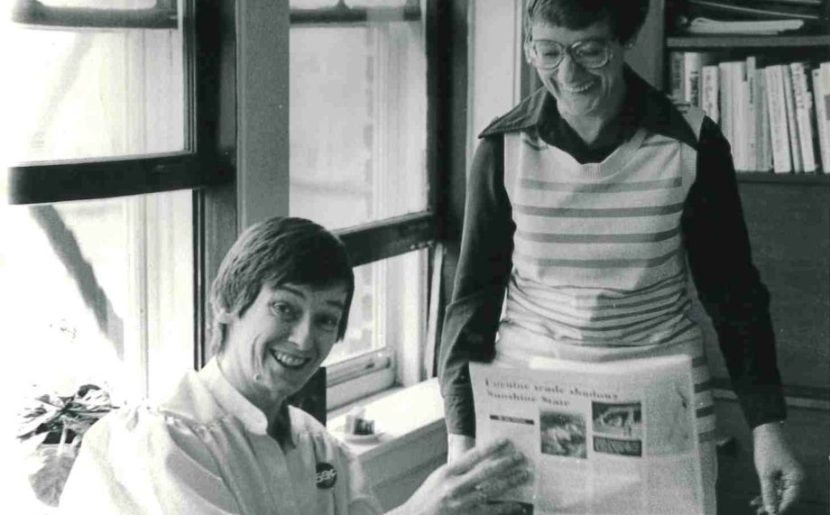
BVMs Letitia “Letty” Close (l.) and Mary Gene Kinney founded ICAP in the 1970s.
by Michelle London
Leadership Conference of Women Religious (LCWR) Region 10 (Iowa, Missouri, and Nebraska) recently honored the ministry of BVMs Mary Gene Kinney and Letitia Marie “Letty” Close.
Sisters of Charity, BVM hosted the event that shone a light on the Inter-Congregational Addictions Program (ICAP) that Mary Gene and Letty founded.
President LaDonna Manternach, BVM says the honor has long been championed by anybody familiar with Mary Gene and Letty’s work in the field of addiction and recovery.
“Region 10 has been a big supporter of both of these women,” she shares. “They saw that they deserved to be honored.”
The Beginning
ICAP was co-founded by Mary Gene and Letty in the 1970s. Both had a strong desire to work in the field of addiction counseling for very personal reasons—Mary Gene was a recovering alcoholic and Letty was the adult child of an alcoholic.
Recognizing a need for support and education in the religious community, they spearheaded 12-step meetings with the BVM Congregation. As word spread, other religious communities started making inquiries. ICAP was born out of that movement.
Based in Chicago, Mary Gene and Letty created an outreach service for women religious with the 12-step program of as its foundation.
“It was about education and the communal aspect of support,” Mary Gene says. “It was about removing the stigma of alcoholism and educating people about it being a disease, not a choice.”
Mary Gene and Letty visited hospitals and clinics, learning as much as they could about individual programs so that they could refer women religious to places where they could receive treatment.
The program expanded to include support for addictions other than alcohol—it has found success for those who have experienced issues with drugs, food, gambling, and overspending.
In 1986, the director of Guest House, a residence for men religious in recovery in Orion, Mich., reached out to ICAP for information on starting a program for women religious.
Knowing that women approached their addictions and recovery differently than men, Letty created an advisory board as Guest House underwent this transition. She would also serve on its board of directors.
Luann Brown, BVM, an addiction therapist, has been a member of ICAP since 2006 and is currently working at Guest House. Women religious, Luann says, often feel alone and hopeless in the disease of addiction.

“One of the great things Mary Gene and Letty have done over the years is to normalize addiction as a disease that people in all aspects of society have,” Luann shares. “And there is a way to recover.”
One Story of Many
Colleen McGinnity, BVM is one of the women religious who reached out for help. It was 1986, and Colleen had been a BVM for 25 years. While she had always been wary of becoming dependent on alcohol due to her family history, it had been the last five years that had proven difficult.
“I contacted another BVM in the community who had identified herself as an alcoholic,” Colleen says. “I said, ‘I have a problem with alcohol.’ She told me to call Letty or Mary Gene.”
ICAP helped get Colleen, who was living in Texas, into treatment in a program in the Chicago suburbs. After three months, she returned to the Rio Grande Valley, but she knew that to succeed in her sobriety, she needed to change her environment.
“I moved to Chicago and connected with several BVM communities,” she says. “The work that Mary Gene and Letty had been doing in raising the issue of alcoholism—that it’s a disease and not a moral failure, that we’re not depraved people who just can’t control ourselves—that was so important.”
Colleen also learned not to hide her addiction, and that revelation came unexpectedly. When attending AA meetings that included lay people, she was careful not to disclose her vocation. She was serving in a parish in Arizona at the time, about three years into her recovery.
“I didn’t want to say I was a nun,” she says. “I kept that to myself. I had heard through the grapevine that one of our parishioners was in AA, so I called him up one night and said I was in AA and really needed to start going to meetings.”
The parishioner said she was welcome to join him and told her he’d save a seat.
“When it came time for announcements, this guy says, ‘This is Sister Colleen. She’s the new nun in our parish,’” Colleen shares. “It just took my breath away. But honestly, after that, everyone knew who I was, and I realized that was okay.”
It was part of Mary Gene and Letty’s philosophy—that there is no shame in sharing that you have an addiction.
“And the communal aspect was big,” Letty says. “Because women do things together, and women talk to each other.”
Soon drug treatment centers were letting Mary Gene and Letty know they would be open to taking referrals from ICAP.
“We had a lot of connections,” Mary Gene said. “But we made it clear we wouldn’t refer just because they had a program for sisters. It had to meet our standards for women’s treatment.”
Hope Prevails
During the course of the evening honoring Mary Gene and Letty, the theme of “Hope” prevailed as women religious and former women religious told their stories of how they had touched their lives.
Letty and Mary Gene were instrumental in helping Guest House launch their women’s program. They also support Transfiguration House in Lviv, Ukraine, which treats both men and women religious.
“There are so many who have benefited from Letty and Mary Gene’s work,” Luann says. “I don’t think we can even count how many. They are two beloved women—pilgrims and prophets, passionate, persistent, perceptive, pragmatic, and playful witnesses.”
The chair of Region 10, Maureen Leach, OSF, presented donations to Guest House and Transfiguration House in honor of Mary Gene and Letty.
“When Region 10 decided to honor these two wonderful women, we asked them, ‘What can we do to honor the valuable service that you have provided?’” Maureen asks. “They said, ‘Give a gift to Guest House and a gift to Transfiguration House.’”
“How Can We Help?”
Colleen’s journey is just one example of the thousands of women religious and, by extension, their loved ones, that have been helped because of Mary Gene and Letty’s selfless service.
Colleen said the social aspect of ICAP was a huge part of her recovery and helped her in relating to other people she would meet in AA.
“I learned I didn’t have to pretend that I was anybody else,” she says. “I was Colleen the alcoholic and it didn’t matter to them, and nobody ever said anything. It didn’t matter that I was a nun. It doesn’t matter if you’re a doctor, a lawyer, a schoolteacher, a guy living off the streets, or a nun. We’re just all here to recover.”
Through the years, Mary Gene and Letty have never wavered from their goal of assisting those who need help.
“Sisters need help. It’s a disease. Who can we reach? How can we help?,” says Mary Gene. “That has always been the goal, and that is still what it is today.”
The mission of ICAP continues to be “Walking with Sisters to Initiative and Sustain Recovery.”
Letty (l.) and Mary Gene (r.) with members of BVM Leadership Anne Marie McKenna (l.), LaDonna Manternach, and Kathy Kandefer at the LCWR Region 10 event honoring them.
 Winter Salt 2026: A Life Commended to God
If you would like to receive Salt, contact the Office of Development for a complimentary subscription at development@bvmsisters.org or 563-585-2864.