Reconnecting the People to the Land
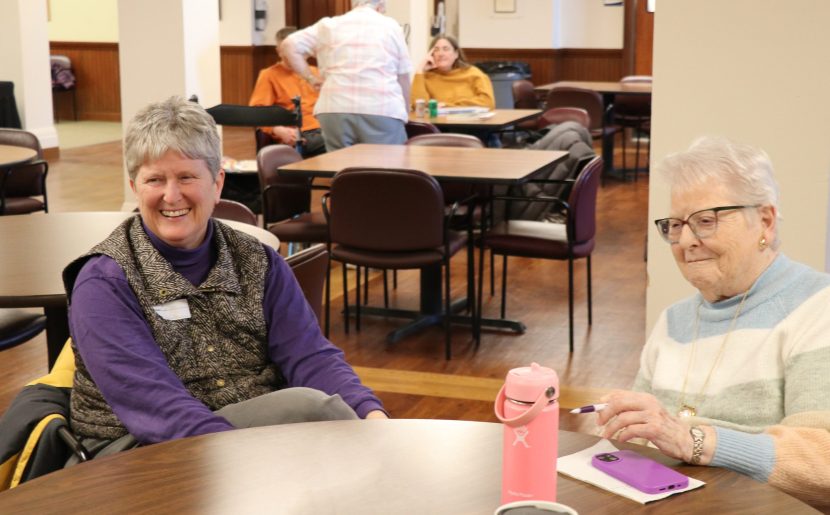
Callie Walker (l.) and Marilyn Wilson, BVM discuss land justice following Callie’s presentation at Mount Carmel Bluffs.
In 1935, around 14 percent of U.S. agricultural land was owned by Black farmers. Today, it is less than 1 percent. Reconnecting people to land is, Callie Walker believes, liberation work.
That conviction is one that the Land Justice Future Committee shares with Callie, and it is why they invited her to Mount Carmel Bluffs to tell her story.
The committee has been engaged in conversations about the roots of land inequity in the United States, particularly the 15th-century Catholic Church Doctrine of Discovery. That doctrine gave European explorers religious and legal justification to claim land in the New World, setting in motion centuries of colonization.
Soon land ownership was protected by laws that made it nearly impossible for Black, Indigenous, and other people of color to own and keep land. Callie’s story offers a living, contemporary response to that tarnished legacy.
Callie, a Methodist pastor from Virginia, grew up on land her father purchased the year she was born. After his death, she came to understand how deeply he knew his children—and how clearly he foresaw their paths.
“Someone told me he’d say, ‘William’s going to farm it, Annie’s going to sell it, and Callie’s going to give it away,’” she recalls. “It just meant so much that he knew me and saw me.”
Callie donated the land to the Central Virginia Agrarian Commons (CVAC), a nonprofit organization where she is a co-founding board member. CVAC exists to ensure land is permanently stewarded by Black and Brown farmers.
Her decision was rooted not only in justice and in faith, but in truth-telling. Callie and her husband, Dan, also confronted the painful history of the land.
“Oh, absolutely, there were enslaved people there,” she says.
Rather than turning away from that reality, Callie leaned into it. Descendants of those enslaved people were invited to walk the property, learn its history, and reconnect with the lives of their ancestors.
BVM Marilyn Wilson notes that understanding Callie’s background as both a Methodist pastor and a land steward illuminates her journey.
“Callie has shown dedication, faithfulness, and remarkable perseverance,” Marilyn says. “She is a delightful person and a great storyteller. I hope we can remain connected as her efforts continue to evolve.”
Zoning challenges and local resistance reshaped Callie’s original vision, but they did not stop it. The current plan divides the land into four farm parcels, each with housing, offered to farmers “as if they had inherited it.” CVAC will begin building the first home on one of the parcels this year.
While no farmer has yet met and/or accepted all of the criteria to steward one of those parcels, there has been keen interest. A mushroom farmer is currently exploring the possibility with CVAC.
“The absence of housing is a limiting factor,” Callie explains. “But hopefully that will change soon.”
Callie’s story offers hope and momentum, demonstrating that the wrongs embedded in land ownership can be addressed creatively and faithfully.
“The more we keep looking, the more we keep rethinking and exploring all of these possibilities,” says BVM Elizabeth Avalos.
Giving the land away, Callie says, is not a loss. It is an exchange for “the world’s best neighbors.”
To learn more, watch: Agrarian Trust: A Gift of Land Justice at tinyurl.com/LandJusticeFuture