A Winding Trail: The BVM Presence in Des Moines
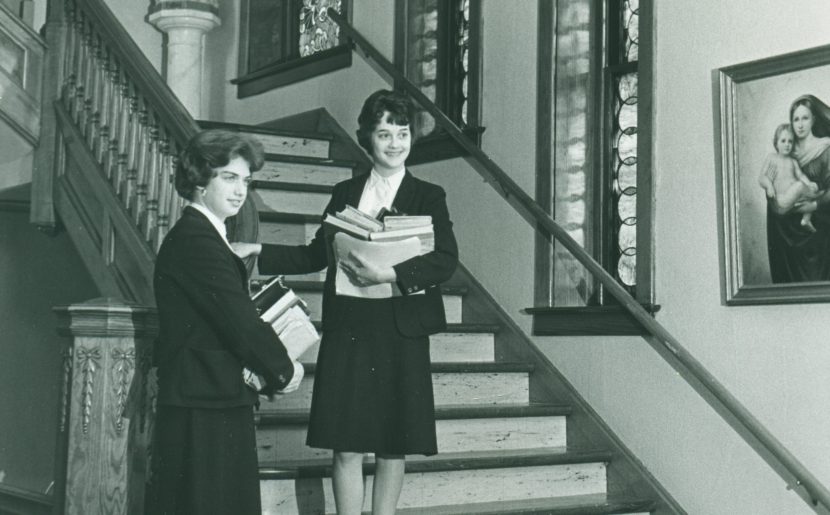
Students on the main staircase of St. Joseph Academy in Des Moines, circa 1961.
by Mira Mosle, BVM
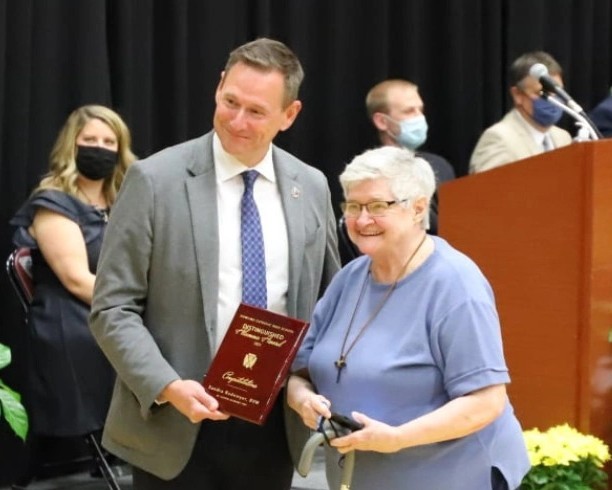
As BVM Sandy Rodemyer’s siblings held a large banner that read “Happy Trails to You” and sang the refrain, it was no ordinary farewell.
Sandy’s move to Mount Carmel Bluffs in Dubuque, Iowa in late September marked the end of 160 years of BVM ministry in Des Moines.
But the beginning was not promising.
A Brief History
In late October 1865, six pioneer BVMs left Dubuque by stagecoach to Cedar Rapids. Heavy snow had fallen a few days before. From there, they boarded a train for Boone, as no railroad ran into Des Moines.
To avoid a collision with an incoming freight train, the passenger train suddenly switched tracks. The rear coach where the sisters were riding became detached as a result and was flung over an embankment into a pond of water. The sisters survived, but they would have to find another mode of transportation.
They hired a stagecoach: “When crossing Skunk River bottom the wheels sunk deep into the mud; the horses reared and plunged and it took very substantial tips to induce the drivers to continue the journey.”
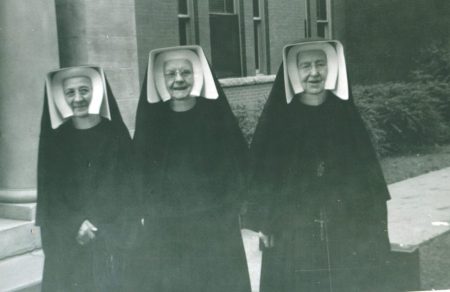
Upon arrival the sisters discovered that an old log church was to be St. Ambrose School. It opened with 250 pupils. The conditions were primitive.
Finding Their Place
The pastor of the only parish in the city, Fr. John Brazill, wanted the sisters to do more than teach. This prompted a response from foundress Mary Frances Clarke, clarifying co-founder Fr. Donaghoe’s belief that, “‘The laborer is worthy of his hire. And to pay and be paid.’ He did not wish the sisters to have anything to do with the choir, altar, or church. Neither make, mend, wash or scrub for it . . . You wish to examine the sisters’ accounts. It is the first time any gentleman, not even our Right Reverend Bishops, required that. Therefore, you will excuse me for positively and finally declining.” Dealing with patriarchy was a constant.
As the city grew, new parishes formed. Visitation Parish began in 1881, and BVMs began a school there in 1882 near the State Capitol. Classes included all eight grades and a high school.
In 1906, St. John’s Parish spun off from St. Ambrose. BVMs staffed that school, too.
Sisters spent Saturdays teaching catechism in small towns near Des Moines, plus summer vacation school. Religion classes for public school students were taught once a week.
But how to provide for the Catholic education of girls not within Des Moines? Mother Clarke was aware of the 24/7 nature of having a boarding academy: “We have five of them now and that is more than enough. Select and parish schools will be less laborious and won’t require so much help.”
She left the decision up to the sisters: “If all conclude it is best to have boarders I won’t object.” Mary Frances’ trust in her sisters resulted in them buying a large home and seven acres outside the city for $25,000.
St. Joseph Academy (SJA) opened in 1885 for girls ages 4–18. When Bishop Austin Dowling opened a boys’ Catholic high school in 1918, all parish secondary schools closed, and SJA became the sole Catholic academy. The elementary grades for boarders ended in 1948. High school boarders continued until 1950.
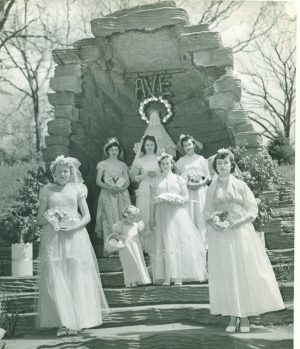
Tragedy struck in 1921 when two sisters were killed by a hit-and-run driver. A grotto to Our Lady of Lourdes was erected as a memorial. This became the site of the May Crowning tradition.
Former Students Reminisce
BVM Kathleen Mullin ’56, recalls, “The high school building size kept enrollment at about 500. Music, art, limited athletic programs, and other after-school happenings reinforced the academic choices for business and college prep curricula. Teachers urged creative thinking, being aware of current affairs and justice issues. We were encouraged to be life-long learners, to live our faith, to care for one another, and to enjoy life!”
Students recall mother-daughter teas, sock hops in the gym, candle lighting, pageants and musicals, the senior class trip to Washington, the Stepperettes drill team, and SALT-Teens community outreach.
For Deborah McKeone ’71, “The greatest gifts from SJA were respect for ourselves as women and as individuals. We learned that we had the capacity for intellectual endeavors and that we could accomplish anything with hard work.”
Classmate Aimee Beckmann-Collier concurred. “Our teachers, both BVMs and laywomen, were intelligent, articulate, and well-suited to serve as role models for high school students on the cusp of maturity. The BVM sisters, like nuns throughout the United States, were, in my opinion, the first feminists.”
For Kathleen Antol ’62, her experiences at SJA were a decisive factor in choosing life as a BVM. “They were always so friendly and genuine with all of us. They were loving toward one another and had fun with each other.”
Growing Enrollment and New Spaces
In the early ’60s, increased enrollment necessitated additional space. A new school was dedicated in 1964 with almost 1,000 students. The future was secure. Or so it seemed.
The boys’ high school needed a new facility. The diocesan decision to build a co-ed school in West Des Moines led to the closure of SJA.
More than 6,000 young women had graduated in its 87-year history. The new Dowling High School/St. Joseph Educational Center opened in 1972.
Sixteen BVMs became administrators and faculty. Others in the city walked new paths as ministers, hospital chaplains, food pantry directors, retreat volunteers, senior day-care administrators, prison volunteers, and diocesan staff. Several moved to Catholic elementary schools.
Over 800 BVMs have been missioned in the Des Moines area. More than 130 women entered the congregation there. Six are currently living at Mount Carmel Bluffs: BVMs Kathleen Antol, Carol Marie Baum, Patricia Donahoe, Dorothy Dwight, Kathleen Mullin, and Sandra Rodemyer.
“In the summer of 1961, I left my home in Des Moines to move to Mount Carmel in Dubuque,” Sandy says. “In September of 2025, I repeated that move for the last time. The trails of my 60 years of ministry were all spent in Iowa. Fifty-seven of those years were spent serving in my home diocese of Des Moines, where my vocation began and was nurtured.”
The trails of service have been winding. The BVM legacy continues in the multi-generational lives of persons served—grounded in love of God, intellectual inquiry, compassionate service, and a thirst for justice.
Mira Mosle, BVM taught at Bishop Austin Dowling High School and worked in the Des Moines Diocese.
Winter Salt 2026: A Life Commended to God
If you would like to receive Salt, contact the Office of Development for a complimentary subscription at development@bvmsisters.org or 563-585-2864.