A Sacred Return: Reflections on Indigenous Cultural Healing
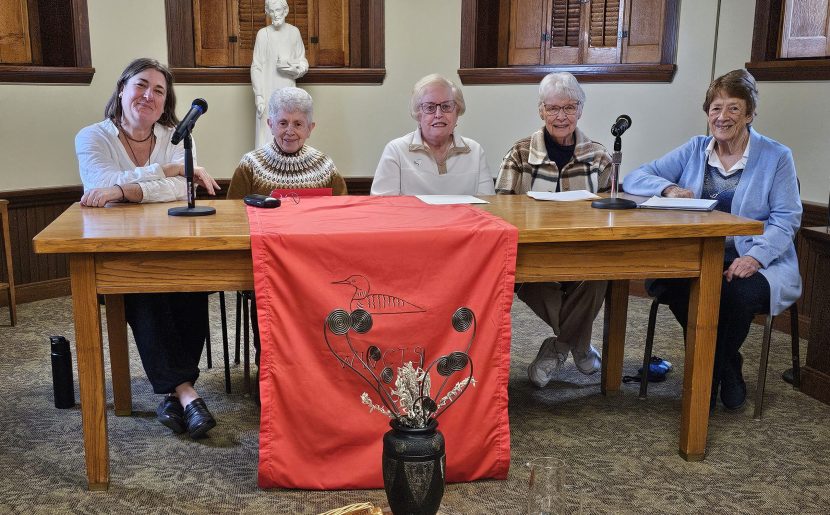
Members of the Land Justice Futures Committee presented a panel to the BVM Congregation on their experiences at the Women and Water symposium in November: Brenna Anglade (l.), and BVMs Ann DeNicolo, Kate Hendel, Colleen McGinnity, and Marguerite Murphy. The loon banner on display was a gift to the sisters from the Lac Courte Oreilles Ojibwe.
In August, members of the Land Justice Futures Committee attended the Women and Water Coming Together Symposium, a four-day cultural and spiritual immersion hosted by the Lac Courte Oreilles Ojibwe community near Hayward, Wis. The symposium presented age-old teachings and rituals that offered the opportunity for unifying and bonding between individuals. Marguerite Murphy, BVM was one of the attendees.
In October, Kate Hendel, BVM, a member of the Land Justice Futures Committee attended a rematriation ceremony that took place between the Franciscan Sisters of Perpetual Adoration (FSPA) and the Lac du Flambeau Band (formerly Ojibwe) of the Chippewa Nation in Arbor Vitae, Wis. The land transfer is the first known between an Indigenous nation and a Catholic institution in the name of reparation.
Both had profound experiences during these solemn, yet joyful, events. We invite you to read about it through their eyes, and reflect on how you can support the committee’s mission of developing relationships with Indigenous peoples and reciprocity of past injustices of the land.
Women and Water Coming Together
by Marguerite Murphy, BVM
We pull into a grassy clearing. Ahead stands long lodge made of young saplings, bent and tied into an oval frame.
As we step from the car, a storyteller shares a creation story while a man restrings a drum. This is Women and Water Coming Together, and we are unsure of what will unfold over the next four days.
Inside the lodge, stacks of fresh-cut wood and chairs await the fire tenders. Ojibwe leaders lay mats and arrange sacred pipes for quiet intention. Their calm presence feel like a lesson.
After two years of listening to speakers and Indigenous individuals share the life-destroying effects from Doctrine of Discovery, and the abuse missionaries and religious permitted at the boarding schools for native Americans, I am thinking, “This is a very peaceful setting.” I know that we will focus on water and that there will be guest speakers, but I have real perception of the wonders that are about to take place.
Outside, participants gather as drums and a tine whistle begin a slow, steady rhythm. We walk around the lodge. At the doorway, a member of the tribe offers a large basket of tobacco, and those entering take a small handful.
As I reached the entrance, I put my hand in the basket to get some tobacco.
“Not with the right hand, use the left hand, please.”
I switch to the left and he explains: “The left hand is closer to the heart where your prayer comes from.”
I quietly thanked him. Throughout the week, I find myself learning this new attentiveness.
There was a care or concern which the members of this Ojibwe tribe gave to the completion of a task, to answer someone’s question, to prepare individuals for the sweat lodge, to elders, and to accept individual needs. Never once was there a sense of hurry or a need to move on. For them, inclusiveness and the time spent sharing were most important.
Wooden blocks are clapped in ritual rhythm. Once the fire is lit, it will burn day and night until the meeting concludes. We approach one by one, offer our tobacco, say a silent prayer, and watch a fire tender place a cedar branch on the fire, causing it to pop and sizzle as it burns.
Each morning brings a ritual honoring the first gifts of the Earth: tobacco, berries, and water. Pipe carriers reconnect their pipes, creating a bridge between Earth and the sacred. One of the firekeepers walks to each attendee and shares the smudge pot, and we draw the smoke over ourselves in prayer. Children carry offerings of berries and water, entirely at home with the ceremony.
Afternoons held stories, songs, and teachings. At meals, the young served the elders before filling their own plates. The rhythm of the days shift gently, guided not by schedules, but by need. I came to understand and appreciate it.
On the final afternoon, we exit the lodge—dancing, laughing, and moving backward into the sunlight—closing as we began: together, present, and transformed.
 A Doctrine of Unity is Enacted. . .
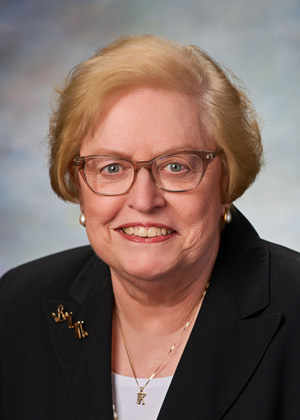
by Kate Hendel, BVM
The story continues. . .
In early October, I was invited by the Land Justice Futures Program to join their team in Arbor Vitae, Wis. for the rematriation ceremony between the Franciscan Sisters of Perpetual Adoration (FSPA) and the Lac du Flambeau Band of the Chippawa nation, federally known as the Ojibwe.
Those who gathered witnessed ancient and yet prophetic signs, shared the water that gives life, gave thanks as the pipe was smoked, felt as one with every beat of the drums, and listened to stories that led these two unlikely partners to share a gift of immeasurable meaning for each. Tears were shed as a gentle, receptive applause followed. Surprisingly, it was not a game-winning type of applause, but rather a gracious acknowledgement of all things coming around right.
The program concluded with a feast. What a grace it was to be present, what a grace to be shared—and unlike the unchristian rationale for and practice of the Doctrine of Discovery, this is exactly what Jesus would do.
I spoke to two young Ojibwe women. Each recalled their grandmothers, who had lived on the island that the lakefront retreat overlooks. They recounted the story of how native children were removed from their homes and placed in schools, and how men and women were marched off the island with guns at their backs.
One of the women, now a tribal councilwoman remembered her grandmother and how she loved visiting her. She told the story of how her grandmother tried to walk home from the school and was caught and brought back. She was then sent to Michigan so she would not be able to find her way home. She shared how she would count the scars on her grandmother’s back that had been received in the convent school. Despite this tragic past, she was grateful for this day. She wanted her young children to be present and to remember this very special event in their tribal story.
Sue Ernster, FSPA president, shared with me that she wondered how the Ojibwe would react to the congregation’s rematriation plan, noting that “History gave them every right to be angry.” But the Lac du Flambeau Band were gracious from the first day forward.
That evening, the Land Justice Futures team gathered around the supper table and, much like Emmaus, talked about the day, each recalling disparate moments that were personally meaningful. A hush filled the space between between stories as each person tried to process the momentous events that had taken place.
All knew that the new “Doctrine of Unity” had been instituted that day, and they were witnesses.
Learn more:
- 2026 Women and Water Indigenous International Clean Water Summit (formerly the Woman and Water Coming Together Symposium)
- Land Justice Futures Program
- FSPA return of Marywood Retreat Center in Arbor Vitae, Wis. to the Lac de Flambeau Band of the Lake Superior Chippewa